For most of my career, picking a technology provider was a one-and-done architecture decision. You had to choose something that could reasonably cover every eventuality over the next 5 years – and off you went.
That is no longer the case, and nowhere is that clearer than with AI. How do you commit to a model for five years when one can be available on Tuesday and geofenced by Wednesday? And the same unease is spreading to cloud. The Bitkom Cloud Report 2026 found that 85% of German companies think the country is too dependent on US cloud providers.
When I read the statistic, my first thought was: a lot of companies are going to start looking for a new provider.
And although I understand the instinct, I don’t think it solves the problem. Because the next provider is just a different logo with its own set of risks. Switch, and you’re still betting on a future nobody can see.
I’d rather hedge my bets. Which means asking a different question: if a model or a cloud you rely on disappeared tomorrow, how quickly could you switch?
Hours, or months of re-engineering plus egress fees?
Infrastructure should be a configuration decision.
Picture an automated warehouse that uses an external machine learning service for route optimization. One morning that service goes offline. Maybe it’s a trade restriction, maybe a technical fault. If nothing else is wired up, deliveries stop going out.
For most customers that’s an annoying delay. For a patient waiting on a prescription refill, or a hospital ward waiting on its restock, it’s much more than that.
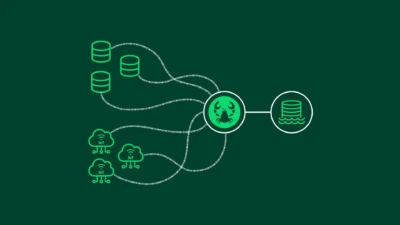
Now, picture the same warehouse with the connection running through an integration layer. The external service only ever received the parameters the calculation needed, and the master data stayed with the company. When the service drops out, the team switches to an alternative AI, a European open source model for example, and the physical control in the logistics center keeps running while they do it.
The underlying AI tooling was identical in both cases. What decided whether the shutdown was a crisis or not was the layer in between.
That layer is where I think companies should be putting their attention.
It sits between your systems and everything they depend on, and it routes data by rules you set yourself, whether that’s criticality or whatever a regulator asked for this quarter. Get it right and changing a dependency is simply a configuration change not a regional medical supply shortage.
Nobody can predict which Cloud you are going to need.
The same thinking applies to the cloud and where the platform itself runs.
Whether or not you are part of the 85% looking to move away from US hyperscalers, their scalability and speed is undeniable. There may be times when your business needs that, and others when you want to shield yourself from foreign policy, and choose a national provider.
Lobster is the same platform whether we host it for you in the Lobster Cloud or you run it in a private cloud in your own account. In France we have validated it for Scaleway, part of the Iliad group, with a hosting zone in Paris and fully European ownership.
That gives customers a sovereign option today, and they can revisit the choice as we add more.
The decision only counts if your team can act on it themselves.
Let’s quickly touch on the elephant in the room: yes, an integration platform is also a commitment.
But without that layer, every model, every cloud and every partner connection is a commitment of its own, wired directly into your systems. Changing any one of them becomes a project, usually sitting in someone else’s queue.
With a user-friendly integration layer in place, it’s a quick change your own team can make. Because that’s the other benefit: when a logistics provider onboards a new partner overseas, or a partner rebuilds their system – your people make the changes directly, wherever the data physically sits.
So, the choice is dozens of commitments that each need unpicking by someone else, or one choice that keeps control with your team.
What becomes possible.
And that is what I’m most optimistic about. When swapping a model, a cloud or a data warehouse is something your own team handles in a week, the energy that used to go into defending a three-year-old infrastructure decision can go into acting on what the data actually shows.
The future-proof architecture was always a bit of a myth. The world changes too quickly for any fixed blueprint to stay right for long. The better answer is to build systems that can respond when the assumptions underneath them change.
You cannot control which cloud provider will have the model you need next year. You cannot control what a regulator will ask for, or what a politician will decide. You can control how easy it is to turn the steering wheel.
At least you can with Lobster.


 Tim Srock, CEO