Skip to content

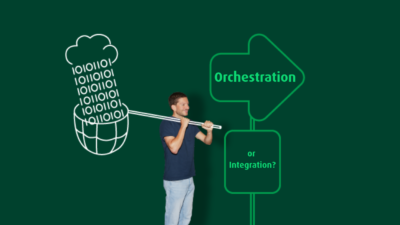
How to know if you need better integration or orchestration.

When a supply chain team tells me they need orchestration, I don’t start with tools. I ask:

„When it breaks, do you get bad data, or a stuck process?“

Bad data points to integration. A stuck process points to orchestration. Let’s get into it:

Bad data? Fix your integration first.

Do any of these sound familiar?

  • A new customer takes three months to onboard because their EDI format doesn’t match yours.
  • Dispatch notices get rejected because a field is missing.
  • Orders arrive twice.
  • A partner switches from EDI to PDF, and someone ends up retyping everything.

Let me say it loud and clear for the people in the back: None of these are process problems.

The process would run fine if the data arrived correctly. So, fix your connectivity, mapping and validation. Better integration will solve these problems. Not (more) orchestration.

Put your focus here first. Because if you put orchestration on top of bad data, you just find out faster that something’s wrong.

A stuck process? That’s process orchestration.

Now imagine your integration works. Every message arrives, in the right format, at the right system. And yet an order can still take a week to do a day’s work. Here’s what that might look like:

Article content
  • Monday:A customer orders 1,000 units. The order is over their credit limit, so finance has to give their approval.
  • Tuesday:Finance approves it, but nobody tells the warehouse. The order sits in the ERP.
  • Wednesday: The warehouse finally picks it, but 400 units are on quality hold. The customer asks when the order will arrive, and customer service has to check three systems to find out.
  • Thursday:The last batch is released and the order ships. The invoice waits another day, because billing only acts on a shipping confirmation someone enters by hand.

Every department did its job and every system works. What’s missing is something that moves the order from one step to the next, and notices when it stops. That’s process orchestration.

In many organisations, that job is still covered by one person with a spreadsheet, a good memory and a direct line to every department. It works remarkably well, until they go on holiday.

Why supply chain orchestration is different.

Inside your own walls, every step in that week runs through systems you control. Every piece is within reach.

Now run the same week through your supply chain.

Article content
  • Monday:The order isn’t waiting on your finance team. It’s waiting on your supplier, who hasn’t confirmed the component.
  • Tuesday:It isn’t your warehouse that hasn’t been told. It’s your customer, whose system has flagged you as late.
  • Wednesday:It isn’t a quality hold. Your carrier can’t collect until your customs broker sends the export documents.
  • Thursday:It isn’t billing waiting on a manual entry. Your carrier’s pickup confirmation never arrives, so there’s no tracking number to trigger the dispatch notice.

Same week, different scale of challenges. You can’t install one engine across all your partners. Your customer, supplier, carrier and broker all run their own formats and systems, and only some will actually pick up the phone.

Between companies, nobody owns the stall, and you can’t make anyone act. What you can do is know exactly what you’re waiting for, from whom and by when.

That means supply chain orchestration has to start from the messages your partners already send. They’re your only evidence of what has – or hasn’t – happened on their side.

Five questions to ask an orchestration vendor.

“So what’s the solve?!” I hear you ask.

Well, if your answer is a stuck process, plenty of vendors will happily sell you orchestration, and the demos will look much the same: a canvas, some boxes, some arrows.

But if you’re looking for supply chain orchestration, you’re going to have to test whether the tool can orchestrate what it doesn’t control.

Here are some questions to get the conversation started:

1. Can it track a process through systems you don’t own?

Your customer, your carrier and your supplier will never work in your tool. If the vendor’s answer starts with „first, your partners log in to…“, it’s built for inside your four walls.

2. Does it work with what partners already send?

EDI, email, PDFs, messages through SFTP. If partners have to change how they work before it’s useful, it won’t be useful for years.

3. Can it tell you what didn’t happen?

Any tool can report a failed message. Ask what happens when the carrier simply never confirms pickup. Silence is how most supply chain processes stall.

4. Does it include the integration underneath?

Orchestration only works on accurate data that arrives on time. A tool that assumes your integration is already perfect is assuming a lot.

5. Can it show me an order that goes wrong?

Every demo shows an order that flows straight through. Ask for one that waits on a partner, misses a deadline and needs escalating on day three.

If the answer to most of these is a log of messages delivered successfully, you’re looking at an integration tool with a fancier interface.

So, bad data or a stuck process?

Next Monday, go through the list of orders that stalled over the weekend and ask the question. If most of it is bad data, fix your integration first. If it’s stuck processes, you need orchestration. And if you’re a supply chain organisation, you need the kind that reaches your customers, suppliers and carriers.

There. Itch scratched, and no egg-laying pig in sight.

Take supply chain orchestration to the next level

If you found this useful, discover how Lobster is combining supply chain orchestration with AI to take things one step further.

Discover more